



An Illustrated History of Chess
Contents:
1 Origins
2 Early Ches
3 Thailand, Burma
4 China
5 From China?
6 Korea
7 Japan
8 Evolution
9 Europe
10 Variants
Exotic Chess
Products
The History
of Chess
How
To Play
Chess from
Around the World
An Illustrated History of Chess_________________3____
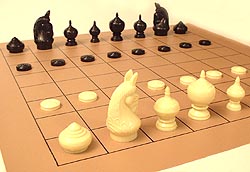 |
Compare
these pieces to the ones we were just examining. The board is
the same, and you can still recognize the horse...but the other
pieces have been replaced by neatly lathed abstractions. Throughout the history of chess, this desire to make lathed pieces has been at work, changing the shape of chessmen.  The pieces here are so similar to each other that you might at
first have trouble telling them apart.
The pieces here are so similar to each other that you might at
first have trouble telling them apart. |
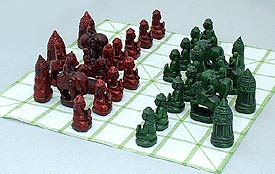
| This is makruk, the national chess of Thailand, still played avidly throughout that country. All pieces, except one, retain the same moves they had in ancient chess, but the former chariot is considered to be a boat, the elephant is now a nobleman, the king's assistant is a seed and the foot soldier is a cowry shell. An interesting mix of changes that fits the local realities of transportation and politics, and the shapes and materials of the playing pieces. | 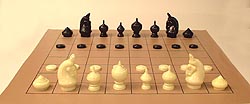 makruk, ready for a first move |
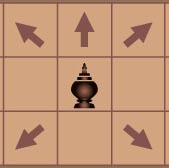 move of the nobleman, the typical "elephant's" move in Southeast Asia |
Note
also that the pawns are placed on the third row, something this
form of chess shares with Japanese chess — as we shall see
later. |
In Burmese chess, sittuyin, that piece moving in those five directions still is an elephant. And you can be sure because the centuries-old figures of chessmen is Burma are literal representations of their battlefield characters. Take a look at the pieces shown here: they are sculpted interpretations of the armed warriors well known from the ancient Persian, Indian and Islamic game. Only the rook is a
little odd. The piece is called a chariot or carriage (in Burmese,
of course), but it is usually depicted as a small ceremonial hut.
|
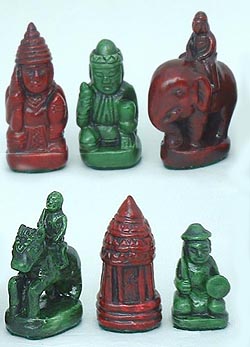 typical Burmese style sittuyin chessmen |
|
But the Burmese game
certainly has a twist of its own —
one of the biggest changes in the history
of the game. For starters, the Burmese pawns are set up far advanced,
some on the 3rd and some on the 4th rows. So far forward that the
first move of the game could be one pawn capturing another. But the big twist is that once the pawns are set up, the players place their pieces wherever they like behind the pawn rows (some restrictions apply). It is as if the whole opening series of moves is done at once and play commences in the middle of the game. |
There
is another lineage of chess which may pre-date these
games altogether! |
HOME
PAGE CHESS PRODUCTS: International | Asian | Reproductions | Unique | Rare | Other Games CHESS HISTORY PAGES: 1 | 2 | 3 | 4 | 5 | 6 | 7 | 8 | 9 | 10 HOW TO PLAY: Chess | Courier Chess | Sittuyin | Xiangqi | Shogi | Shatranj | Janggi Makruk | Shatar | Dou Shou Qi | Luzhanqi LINKS: Chess Variants | Chess History | Chess Articles | Mah Jongg AFFILIATED SITES: Rick Knowlton | Courier Chess | Knowlton Mosaics Ken Knowlton | Insite Age | VerySpecial.us CONTACT US |